
When Everyone Made the Right Decision, How Did the Business Lose Control?
Most organisations don’t deliberately create a fragmented management environment.
It happens one sensible decision at a time.
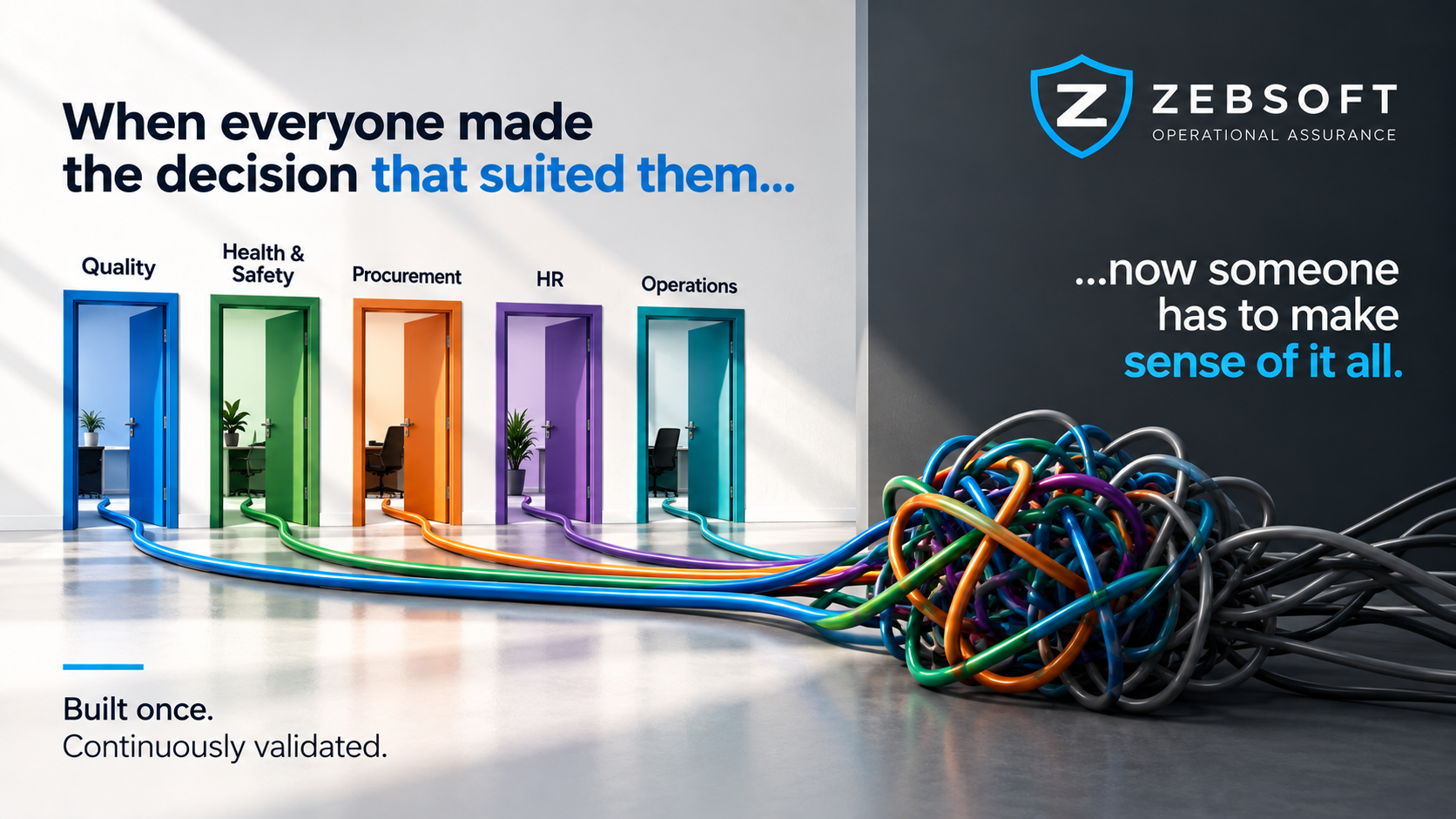
Quality needs better control, so it implements a Quality Management System.
Health & Safety has different requirements and selects a platform designed around them.
Procurement needs greater visibility of suppliers. HR needs to manage training and competency. Operations needs better workflows.
Each decision has an owner. Each solves a genuine problem. Each probably has a perfectly reasonable business case.
Then, several years later, somebody looks across the whole organisation.
And what they find can be very different from what anyone originally intended.
Nobody designed the system you now have
The individual applications may all work perfectly well.
The problem is what happens between them.
The same employee exists in several systems. The same supplier appears in different databases. Actions are raised in multiple places. Documents are controlled differently depending on which department owns them.
Information needed by management is distributed across platforms that were never designed to work together.
So the organisation does the logical thing.
It integrates them.
APIs connect one system to another. Data is synchronised. Dashboards are created. Additional technology is introduced to make the existing technology work together.
APIs are extremely useful. We use them ourselves.
But there is an important distinction:
Integration can make separate systems communicate. It doesn’t necessarily remove the reason they became separate in the first place.
At some point it is worth asking whether integration is solving the problem — or simply managing the complexity the organisation has accumulated.
Have we digitised the business — or digitised the silos?
This is where the issue becomes bigger than software.
The Quality Manager quite reasonably looks after Quality.
The Health & Safety Manager looks after Health & Safety.
Procurement looks after suppliers.
HR looks after people.
Operations looks after operations.
Nobody has necessarily made a bad decision.
The problem is that everyone made the decision that suited their part of the organisation.
Eventually someone has to make sense of the whole thing.
That is when departmental software becomes an organisational issue.
Multiple suppliers and contracts are only part of it. There can also be duplicated information, overlapping functionality, inconsistent workflows, separate reporting structures and an increasing dependency on integrations.
Management wants a coherent view of the organisation.
IT has to maintain the environment that produces it.
What genuinely needs to be separate?
This isn’t an argument for putting everything into one piece of software.
Some systems are specialist for very good reasons.
Finance, engineering, production, clinical systems and other specialist applications may perform functions that a general management platform should never attempt to replace.
The more useful question is:
Which activities genuinely need specialist systems — and which are separate simply because different departments bought them separately?
Look across most organisations and apparently different management functions begin to share remarkably similar requirements.
They need controlled information.
They need responsibilities and actions.
They need competent people.
They need risks managed.
They need suppliers controlled.
They need audits, reviews and evidence.
And ultimately, management needs to know what is happening.
The departmental context may be different.
The underlying management activity often isn’t.
Before buying the next system
Perhaps the question shouldn’t only be:
“Does this application solve the department’s requirement?”
There should be another question:
“What are we already doing elsewhere in the organisation that this new system is about to duplicate?”
And perhaps another:
“Could these requirements operate within a common management environment instead?”
That conversation needs to happen above the individual department.
Because once an organisation has accumulated enough separate systems, the challenge is no longer finding another application capable of solving another problem.
It is regaining control of the environment those decisions have collectively created.
From integration to operational assurance
This is the thinking behind Zebsoft.
Zebsoft doesn’t assume every specialist system should disappear. Its API exists precisely because there will always be systems that should remain specialist.
But common management activities don’t necessarily need to be fragmented simply because they belong to different departments.
Bringing those activities together creates something more valuable than software consolidation.
It creates the ability to connect what the organisation has defined with what people are actually doing — and the evidence that demonstrates it.
That’s Operational Assurance.
Perhaps the next stage of digital transformation isn’t another system.
Perhaps it’s making sense of the systems you already have.