
SYSTEM INFORMATION
Sectors: Compliance Software by Sector Explained
Different Operating Environments. One Connected Assurance Platform.
Compliance software by sector should reflect real differences in risk, obligations, language, participants and evidence without creating another isolated system for every industry. Zebsoft applies shared assurance capabilities within the context each organisation actually operates.
THE SHORT ANSWER
The Sector Provides Context. The Platform Provides Structure.
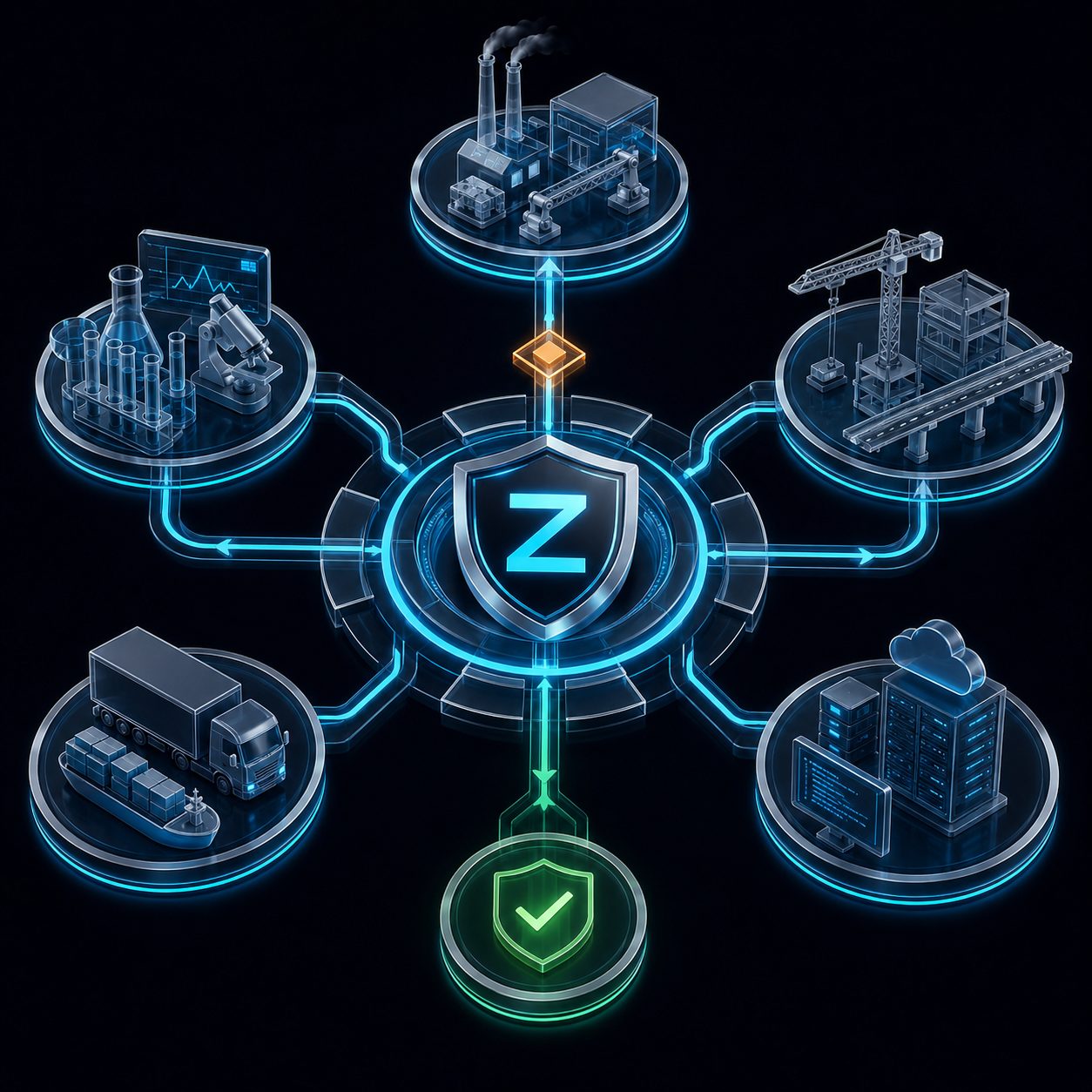
Manufacturers, facilities operators, professional advisers and critical services do not face identical risks or scrutiny. They do, however, share the need to define requirements, assign responsibility, operate controls, coordinate people, retain evidence and respond when expectations are not met.
The objective is not to make every sector look the same. It is to reuse structure where duplication adds no value while preserving the detail that makes the organisation’s controls credible. A supplier approval workflow, for example, can use the same underlying engine in engineering, facilities and regulated services; the questions, evidence, risk classifications, reviewers and continued-monitoring rules can remain different.
This also supports organisations working across more than one sector. Shared governance can remain consistent while each operation retains its own language, competent specialists, customers, obligations and assurance evidence.
KEEP THE CONCEPTS DISTINCT
Sector, Domain, Standard, Capability and Organisation Profile
These terms describe different dimensions of the operating model. Treating them as interchangeable creates confusing navigation and duplicated system design.
| Concept | What it describes | Example | How it works in Zebsoft |
|---|---|---|---|
| Sector | The external and operational environment in which the organisation works. | Manufacturing, facilities management or professional services | Shapes terminology, risks, stakeholders, obligations and evidence expectations. |
| Domain | An organisational subject requiring coordinated governance and assurance. | Quality, health and safety, information security, assets or suppliers | Organises relevant risks, controls, workflows and evidence within the sector context. |
| Standard or framework | A defined set of external requirements, guidance or assessment criteria. | ISO 9001, ISO 45001 or a contractual framework | Requirements can connect to organisational controls without becoming the complete operating system. |
| Capability | A reusable function through which controlled work is performed. | Audit, risk, documents, incidents, training or change | The same capability can operate across several domains and sector requirements. |
| Organisation profile | Scale, structure, maturity and delivery model rather than industry. | Growing, multi-site, group, regulated or supply-chain dependent | Influences deployment, permissions, workflow depth, portals and management views. |
WHAT CHANGES BY SECTOR
Configure the Context Around Operational Reality
Sector configuration should influence how the system operates, not merely replace one label with another.
WHAT REMAINS COMMON
A Shared Assurance Structure Across the Organisation
Even where context differs, the organisation benefits from consistent ways to assign responsibility, operate workflows, retain evidence and expose exceptions.
THE OPERATING MODEL
Define, Communicate, Operate and Assure in Sector Context
The operating model remains consistent while the content, competence, evidence and depth reflect the sector and organisation.
Sector requirement → operational context → owned control → configured workflow → evidence → competent verification → exception or assurance
SUPPLY CHAIN-DEPENDENT ORGANISATIONS
Extend Assurance Beyond the Organisational Boundary
Many sectors depend on suppliers, contractors, outsourced processes and service partners. The sector changes the evidence and risk criteria; the platform provides controlled participation and connected oversight.
ORGANISATION PROFILE IS A DIFFERENT DIMENSION
Growing, Multi-Site and Group Organisations Are Not Sectors
Scale and maturity influence how the platform should be adopted, but they do not identify the industry. The same sector can contain a small organisation formalising its first controls and a complex group coordinating several sites and frameworks.
AN ASSURANCE LAYER AROUND SPECIALIST TOOLS
Sector Expertise Does Not Require Zebsoft to Replace Every Technical System
Manufacturing, facilities, security, finance, healthcare and other sectors use specialist systems for technical or transactional work. Zebsoft can provide the governance, workflow, evidence and oversight surrounding those systems without pretending to perform their specialist purpose.
ONE WORKFLOW ENGINE. DIFFERENT SECTOR CONTEXT.
The Same Change Pattern Can Carry Different Control
Consider an equipment or system change. The basic assurance route is recognisable across sectors, but the assessments, specialists and evidence vary materially.
A facilities change may emphasise contractor control, permits and site safety. A manufacturing change may emphasise specification, validation and product acceptance. An information-security change may emphasise access, testing, rollback and data risk. The platform route remains connected while competent people define the sector-specific control.
REUSE WITHOUT BLURRING SCOPE
One Organisational Control Can Support Several Requirements
Sectors frequently face overlapping standards, contracts and regulations. Duplication can be reduced by connecting each requirement to the organisational control and evidence that genuinely support it.
WHAT CONFIGURATION LOOKS LIKE IN PRACTICE
Sector Relevance Is Built Through Connected Detail
A sector label on a dashboard does not make software industry-specific. Relevance comes from configuring the information, relationships and controlled activity around how the organisation really works.
CONFIGURE FROM THE OPERATING MODEL
Start With the Organisation—not a Generic Industry Template
A sector template can provide useful structure, but implementation must reflect the organisation’s actual scope, risks, responsibilities, systems, evidence and priorities.
RESPONSIBLE AI. SECTOR COMPETENCE REMAINS HUMAN.
Interrogate Approved Information Without Automating Interpretation
Where enabled, AI can help authorised users interrogate and summarise approved information, surface relationships and identify potential gaps for review. It has no authority to determine applicable law, interpret a specialist requirement, assess technical risk, approve a control or reach an assurance conclusion.
No software can guarantee sector compliance or control effectiveness. Zebsoft supports the approved operating and assurance process.
PRACTICAL QUESTIONS
Compliance Software by Sector FAQs
Sector configuration should make the platform relevant without replacing the specialist competence and systems on which credible governance depends.
What is compliance software by sector?
Compliance software by sector applies common governance and assurance functions to the risks, terminology, obligations, participants and evidence expectations of a particular industry. Zebsoft adapts the connected system context without creating a separate platform for every sector.
Is a sector the same as a Zebsoft domain?
No. A sector describes the organisation’s operating environment. A domain is a subject such as quality, health and safety, information security, assets or suppliers. One sector usually needs several domains, and one domain can apply across many sectors.
Does Zebsoft contain every industry regulation?
No. Applicable law, regulation, contracts and sector rules must be identified and interpreted by competent people. Zebsoft can structure approved requirements, controls, responsibilities, workflows and evidence once the organisation has established what applies.
Can the same control support several standards?
Yes. One organisational control may contribute to several requirements. Zebsoft can retain those relationships while each standard or framework keeps its own scope, evidence expectations, testing and assurance conclusion.
Do we need a different system for each business unit?
Not necessarily. Sites, entities and business units can use shared capabilities and organisational information while permissions, workflows, terminology and management views preserve the context that differs. The appropriate architecture depends on governance, confidentiality and operating needs.
Can Zebsoft support a highly specialised sector?
The platform can be configured around specialist terminology, classifications, workflows, evidence and relationships. Suitability depends on the actual requirements and whether Zebsoft should operate the assurance layer or a specialist technical system should perform the underlying technical work.
Is a growing organisation a sector?
No. Growth is an organisational profile or stage. A growing business may belong to any sector. Its main need is often to introduce proportionate structure that can expand without recreating every process as complexity increases.
Does AI interpret our sector obligations?
No. AI may help authorised users interrogate approved information where enabled. Competent people remain responsible for identifying obligations, interpreting requirements, assessing risk, approving controls and reaching assurance conclusions.
EXPLORE THE SYSTEM FROM THE RIGHT ANGLE
Move From Sector to Use Case, Domain or Capability
This page explains sector context. Use Cases shows common assurance scenarios, Domains Explained organises operational subjects and Modules describes the reusable capabilities used across sectors.