
ISO 27001 CONTROL GOVERNANCE. HUMAN ACCOUNTABILITY. 

ISO 27001 Statement of Applicability Software

Human Decisions, Connected Evidence and Defensible Control Governance

Zebsoft provides a controlled environment for maintaining the Statement of Applicability that supports an ISO/IEC 27001 information security management system. It connects applicability decisions, justification, implementation status, ownership, risks, evidence, review and approval without pretending that software can make the organisation’s decisions.

ZAP AI may interrogate approved information, analyse relationships and identify matters for review. It does not invent controls, fabricate evidence, approve the SoA or accept risk. Authorised people remain responsible for every decision and every statement. 
  • Maintain a controlled SoA register rather than an isolated spreadsheet
  • Link each control decision to risk treatment and supporting context
  • Separate claimed implementation from evidence of operation and effectiveness
  • Record human review, challenge, approval and change history
ISO 27001 Statement of Applicability governance with human approval and connected evidence

WHAT THE SoA ACTUALLY GOVERNS 

A Controlled Record of Security Decisions

The Statement of Applicability is not a catalogue of software features and it is not a declaration that every Annex A control must be adopted. It records which controls the organisation has determined are necessary, why controls are included, whether they are implemented and why any Annex A controls are excluded. 


Decision context

The SoA should make sense when read alongside the ISMS scope, information-security risk assessment, risk-treatment process and relevant legal, regulatory, contractual and customer requirements. 


Control position

Each entry needs an intelligible applicability position and rationale. A status without context does not explain the organisation’s reasoning or accountability. 


Current governance

Ownership, implementation, evidence, approval and review should remain controlled as systems, threats, suppliers, obligations and business activ ities change.

Zebsoft structures and connects the record. The organisation decides what is necessary and remains accountable for that decision. 

RISK TREATMENT BEFORE CHECKLISTING 

Annex A Is a Reference Set, Not a Substitute for Judgement

The organisation determines the controls needed to treat its information-security risks. Annex A is then used as a reference to check that necessary controls have not been omitted. Controls may also arise from legislation, regulation, contracts, customer requirements, sector rules, technology architecture or the organisation’s own design.

A copied control list with generic justifications may look complete while concealing weak reasoning. The better question is not “Have we ticked every box?” but “Can we explain why this control is or is not necessary in our context?” 

What a credible SoA should reveal

  • The ISMS scope and risk context behind the decision
  • Controls selected through risk treatment, including controls outside Annex A where necessary
  • A reasoned inclusion or exclusion position
  • Whether the control is implemented—not merely planned or discussed
  • The people authorised to own, review and approve the position
  • Evidence that can be examined without overstating effectiveness

THE GOVERNED SoA LIF ECYCLE

From Scope and Risk to Review and Approval

Zebsoft can organise the work around the SoA while keeping decision authority with competent people. 

01 

Define scope

Authorised management establishes the boundaries, interfaces, activities, locations, technology and exclusions relevant to the ISMS. 

02 

Assess risk

People identify information-security risks, evaluate them using the approved method and determine treatment priorities. 

03 

Determine controls

Control needs are selected from risk treatment, obligations and operational context—not generated from a generic prompt. 

04 

Decide applicability

Competent owners decide inclusion or exclusion and record the reasoning for the organisation’s position. 

05 

Plan implementation

Accountable owners define what will be implemented, by whom, where, when and with what acceptance criteria. 

06 

Link evidence

Policies, configurations, training, supplier records, tickets, tests and other evidence are connected to the relevant control. 

07 

Review and approve

Authorised people challenge the rationale, resolve gaps, accept residual risk and approve the controlled SoA. 

08 

Monitor change

Risk, incidents, audits, technology and obligations trigger review so the SoA does not become a dated snapshot.

ONE CONNECTED CONTROL REGISTER 

What Zebsoft Statement of Applicability Software Controls

The platform provides structure, routing and traceability around each control record. Configuration should reflect the organisation’s own ISMS design and authority model. 


Control identity

Maintain the control reference, title, theme, source and any organisation-specific control without losing its provenance. 


Applicability rationale

Record inclusion or exclusion reasoning in a required field rather than leaving an unexplained status in a spreadsheet. 


Implementation status

Distinguish planned, partly implemented, implemented and review states using the organisation’s approved definitions. 


Named ownership

Allocate responsibility for maintaining the control and its evidence while preserving management accountability. 


Risk relationships

Connect controls to identified risks, treatment actions and residual-risk decisions so the reasoning can be followed. 


Evidence links

Associate approved documents, records, audits, training, tests, incidents and actions without treating an attachment as proof by itself. 


Review scheduling

Set review dates, notifications and escalation paths appropriate to risk, change and the organisation’s governance rules. 


Controlled history

Retain changes to status, rationale, ownership, evidence and approval so reviewers can understand how the position evolved. 

RESPONSIBLE AI WITHIN THE ISMS 

Interrogate, Analyse and Challenge—Never Invent Responsibility

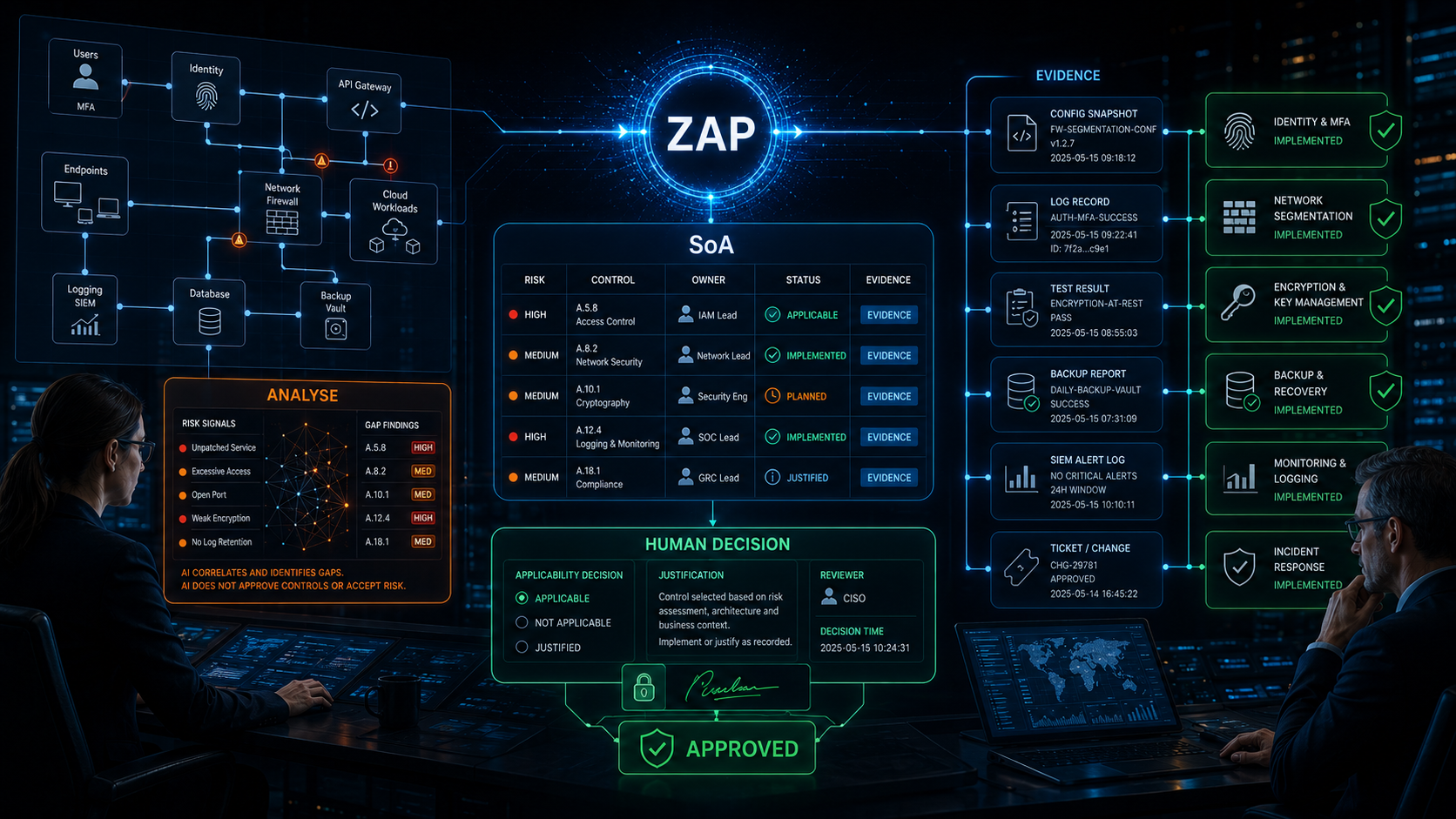
ZAP AI is used as an analytical assistant over information the organisation has authorised it to examine. It can help a reviewer navigate a large SoA, compare related records and bring possible inconsistencies to attention. Its output is a prompt for human investigation, not an organisational decision.

We deliberately reject the idea that an AI should generate a polished but unsupported SoA. A plausible paragraph is not evidence. A suggested justification is not risk acceptance. A statistical answer is not management approval. 

  • Identify controls with missing, duplicated or unusually generic rationale
  • Flag conflicts between applicability, implementation status and linked evidence
  • Surface stale evidence, overdue reviews, unassigned ownership or unresolved actions
  • Compare control records with risks, incidents, audits, policies and training records
  • Summarise authorised evidence for a reviewer while retaining links to the source
  • Record whether a human accepted, rejected or investigated an AI-raised observation

AI does not approve the SoA. It does not define scope, decide applicability, justify exclusions, accept residual risk, attest implementation or fabricate policies, records or evidence. 

ZAP AI analyses SoA evidence and routes observations to accountable human reviewers

DECISIONS BELONG TO PEOPLE 

Human Accountability Is Designed Into the Workflow

Responsibility cannot be delegated to an algorithm. Zebsoft can route decisions to the right role and retain the record of review, but the organisation defines who is competent and authorised. 


Top management

Sets direction, provides resources, reviews performance and remains accountable for the effectiveness of the ISMS. 


ISMS manager

Coordinates the SoA, protects its integrity and ensures decisions are routed through the agreed governance process. 


Risk owner

Evaluates treatment choices and makes or escalates residual-risk acceptance within delegated authority. 


Control owner

Maintains implementation, operational evidence, review activity and actions for the assigned control. 


Internal auditor

Independently examines conformity and effectiveness; the auditor should not own the controls being audited. 

An AI-generated recommendation may inform these people. It never replaces their competence, authority, professional judgement or recorded decision. 

ISO/IEC 27001:2022 ANNEX A 

Organise the Reference Controls Without Losing Risk Context

The 2022 control set is organised into four themes. Zebsoft can present those controls alongside organisation-specific and externally required controls, while the organisation determines what is necessary. 


Organizational controls

Governance, policies, responsibilities, suppliers, incidents, continuity, legal obligations and related organisational arrangements. 


People controls

Screening, terms of employment, awareness, disciplinary processes, remote working and reporting responsibilities. 


Physical controls

Perimeters, entry, facilities, monitoring, equipment, media, clear desk and protection from physical or environmental threats. 


Technological controls

Identity, access, authentication, malware, vulnerability, logging, network, development, configuration and other technical safeguards. 

ISO/IEC 27002 provides implementation guidance for information-security controls. It does not replace the organisation’s own risk treatment, design choices or accountability. 

Live ISO 27001 SoA register with control ownership risk links evidence and review status

FROM ASSERTION TO EXAMINABLE EVIDENCE 

An Attachment Is Not Automatically Proof of Control Effectiveness

A policy can show that a control was designed. A configuration record may show that it exists. Logs, samples, tests, interviews, incident outcomes and audit results may provide evidence about whether it operates and achieves the intended result. Those are different assurance questions.

Zebsoft can connect each control to several evidence types and retain review history. The reviewer decides whether the evidence is authentic, relevant, sufficient, current and within scope. 

  • Design: what the approved control is intended to do
  • Implementation: whether the control has been put in place
  • Operation: whether the control is being performed as defined
  • Effectiveness: whether the control contributes to the intended risk treatment
  • Exception: what gaps, incidents, findings or accepted limitations remain

KEEP THE SoA CURRENT 

Review When the Organisation or Its Risk Changes

A review date helps, but material change should also prompt attention. ZAP can monitor connected records and raise a review task without silently rewriting the approved SoA. 


Technology and architecture

New systems, cloud services, integrations, remote-working arrangements, data flows or material configuration changes may affect existing controls. 


Threats and events

Incidents, vulnerabilities, threat intelligence, audit findings and control failures may challenge assumptions or show treatment is inadequate. 


Business and obligations

Scope, sites, services, suppliers, contracts, laws, customer requirements, acquisitions and organisational roles may change applicability. 

New or changed AI use is also a review trigger

When the organisation adopts AI services, it should assess information assets, data flows, suppliers, access, privacy, accuracy, security, retention and human-oversight risks. The ISMS can govern those risks; ISO/IEC 42001 may provide a complementary management-system framework for responsible AI use. The two standards should not be presented as interchangeable. 

A REAL-WORLD REVIEW ROUTE 

When AI Analysis Finds a Weak Control Record

The analytical output starts a controlled question. It does not produce an approved answer. 

01 

Observation

ZAP identifies that a control is marked implemented, but linked evidence is old and the owner has changed. 

02 

Human triage

The ISMS manager decides whether the observation is relevant, false, duplicated or requires investigation. 

03 

Owner response

The authorised control owner provides current evidence, raises an action or corrects the status with an explanation. 

04 

Approval

The appropriate risk or management authority reviews the impact and approves any change to applicability or risk acceptance. 

The result is a traceable chain from machine-raised observation to human examination, evidence and authorised decision. 

MANAGEMENT AND AUDIT VIEW 

Report the Position Without Hiding Its Limitations

Dashboards and exports can help management and auditors navigate the SoA, but presentation should not turn uncertainty into a green badge. A useful view distinguishes complete records from overdue reviews, unsupported claims, open actions and unresolved exceptions. 

  • Applicability and exclusion decisions awaiting approval
  • Controls without current owners or review dates
  • Implementation status by theme, site or accountable role
  • Controls with weak, expired or missing evidence
  • Open risks, audit findings, incidents and treatment actions
  • Full change and approval history for the controlled SoA

The organisation defines reporting criteria and decides what the indicators mean. Zebsoft displays recorded information; it does not certify that the organisation conforms. 
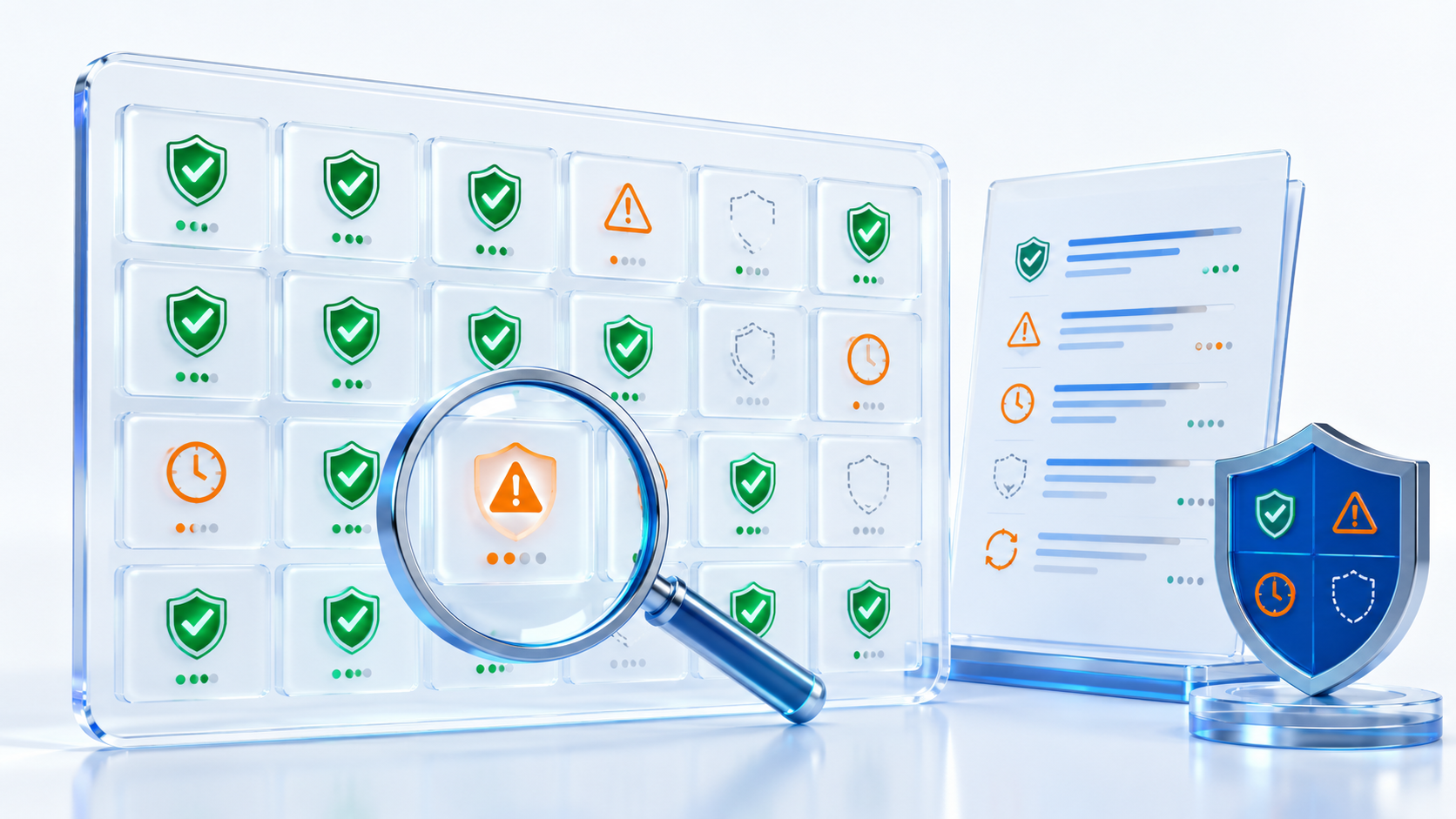
ISO 27001 SoA dashboard with implementation evidence gaps overdue reviews and approvals

CONNECTED ISMS GOVERNANCE 

The SoA Makes More Sense When Its Sources Remain Connected

A static export may satisfy a document request, but the working governance value comes from links to the records that explain and test the control position. 


Risk management

Connect control selection and treatment decisions to the live risk context. Explore risk management software


Document control

Link approved policies, standards, procedures and technical information without confusing documents with operating evidence. Explore document control


Audit and assurance

Use audits to examine whether controls operate as intended and route findings into accountable action. Explore the auditing platform


People and training

Connect role, competence, awareness, acknowledgements and assigned responsibility to the controls that depend on people. 

CLEAR PRODUCT BOUNDARIES 

What Zebsoft Supports—and What the Organisation Must Supply

Zebsoft can support

  • A structured control register with configured fields and statuses
  • Workflow for review, challenge, approval, actions and reminders
  • Links between controls, risks, evidence, documents, audits and people
  • Traceable history and reporting over authorised records
  • AI-assisted interrogation and analysis with source-linked human review

The organisation remains responsible for

  • Defining ISMS scope, context, risk criteria and method
  • Identifying risks and determining necessary controls
  • Making and justifying applicability or exclusion decisions
  • Implementing controls and supplying authentic evidence
  • Evaluating effectiveness, accepting risk and approving the SoA
  • Meeting applicable legal, contractual, regulatory and certification requirements

INFORMED IMPLEMENTATION 

Standards References and Practical Questions

Use the licensed standards and competent advice applicable to your organisation. Product content is informative and is not certification, legal advice or a substitute for the standard. 


ISO/IEC 27001:2022

Specifies requirements for establishing, implementing, maintaining and continually improving an ISMS. View the official ISO standard page


ISO/IEC 27002:2022

Provides guidance and good practice for information-security controls used within an ISMS. View the official ISO standard page


ISO/IEC 42001:2023

Provides a management-system framework for responsible development, provision or use of AI systems. View the official ISO standard page

Can AI write our Statement of Applicability?

It can assist analysis and drafting for human review, but Zebsoft’s approach is not to manufacture an approved SoA. Scope, risk treatment, applicability, exclusions, evidence, risk acceptance and approval require authorised human judgement. 

Does every Annex A control have to be implemented?

No blanket answer should be generated. The organisation determines necessary controls through risk treatment and other requirements, uses Annex A as a reference and justifies exclusions in its SoA. 

Does linked evidence prove effectiveness?

No. It makes evidence accessible and traceable. Competent reviewers and auditors still evaluate authenticity, relevance, sufficiency, currency, operation and effectiveness. 

Can Zebsoft guarantee certification?

No. Zebsoft provides governance capability. Certification depends on the organisation’s ISMS, implementation, evidence and independent assessment against applicable requirements. 

SEE THE GOVERNED SoA WORKFLOW 

Bring a Real Control Decision—Not a Generic Checklist

Use one genuine example in a demonstration: a control with a disputed applicability decision, changing evidence, an overdue review or an AI-raised inconsistency. We can show how ZAP links the sources, routes human review and retains the accountable decision.