

PRACTICAL WORKFLOW GUIDE · SOUTH AFRICA

From Recurring Audit Findings to Effective Action in South Africa

A finding can be marked closed while the same weakness continues at another plant, depot or customer site. For South African quality and technical-service teams, the useful question is whether the response changed the operating condition. This guide connects the finding, investigation, action and effectiveness review without treating administrative closure as assurance.
South Africa software and assurance overview

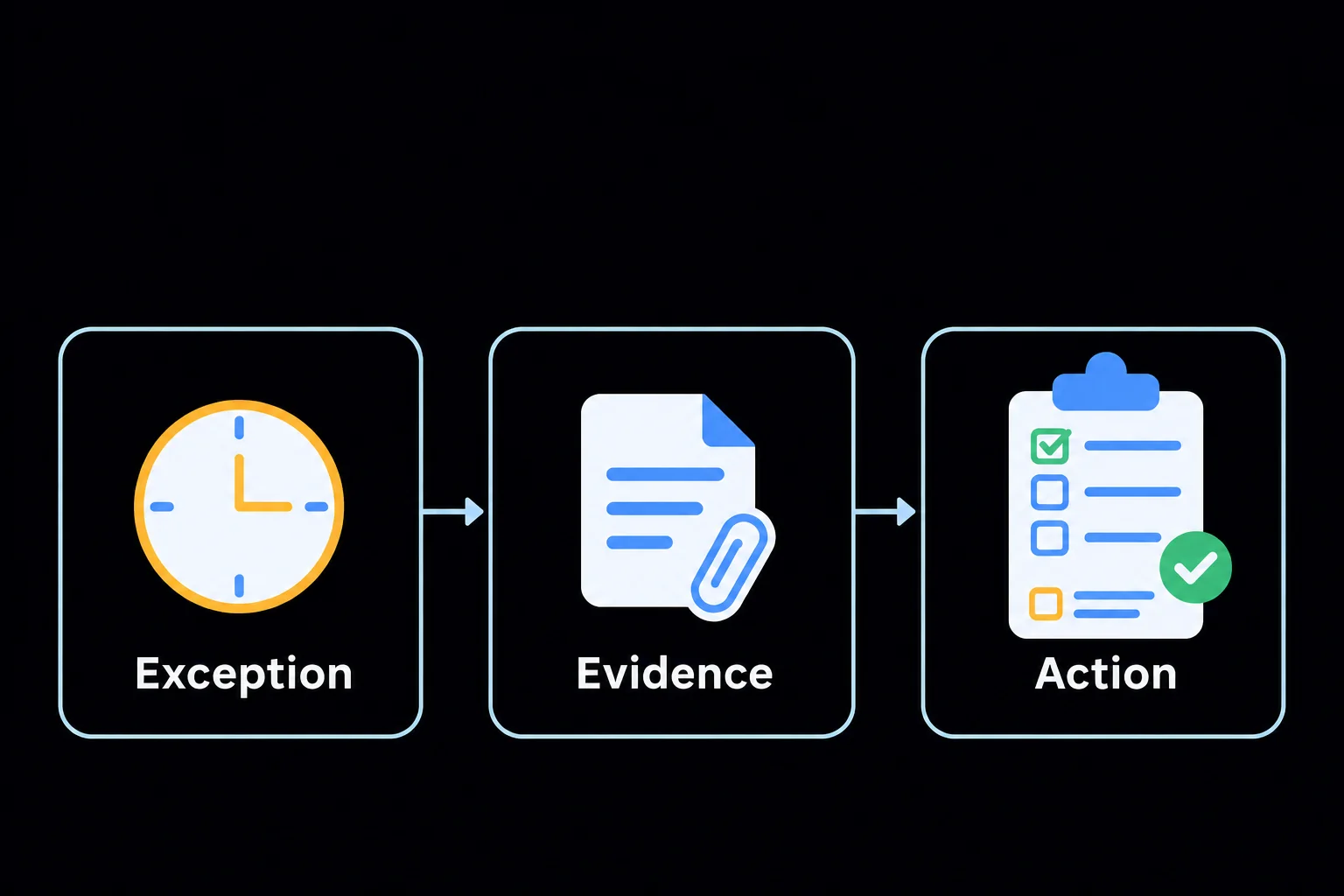
An exception remains connected to its supporting evidence and a responsible follow-up action.

An Illustrative Operating Scenario

Illustrative scenario: a manufacturer has repeated findings about obsolete work instructions. One team has replaced its copies, but later audits identify the same issue elsewhere. Management needs to understand whether this is an isolated document problem or a weakness in how changes reach the workforce. The example describes a management workflow, not a customer result or a legal interpretation.

Investigate the Pattern Before Closing the Finding

1. Describe the observed condition

Record what the auditor observed, the process and location involved, and the requirement against which it was assessed. Link the evidence rather than relying on a label such as documentation issue. A clear finding allows the responsible team to investigate the actual condition and limits later disagreement about what needs to change.

2. Contain the immediate problem

Identify the immediate response needed and who is authorised to decide it. In the example, the team may need to review which instruction is current and communicate the approved information. Retain this response separately from the longer-term corrective action so an urgent correction is not mistaken for resolving the underlying cause.

3. Examine related records and locations

Review earlier findings, document history, reading records, competence evidence and relevant risks. Look for common process features rather than assuming that similar wording proves an identical cause. Establish which locations are in scope and record the limitations of the evidence available to the investigation.

4. Agree an action and success criteria

Give the corrective action an owner, implementation date and expected operating result. State how the result will be assessed. For obsolete instructions, uploading a new file may be an implementation step; a useful success criterion concerns whether the relevant workforce can find and use the approved information.

5. Review implementation evidence

Check what was actually changed, where it was applied and who reviewed the result. Retain the evidence supporting implementation and any remaining exceptions. If the action affects additional roles or sites, verify that the agreed scope was addressed rather than assuming a central change reached every operating location.

6. Test effectiveness and retain the decision

Use the agreed review point to assess whether the weakness has recurred and whether the action achieved its intended result. The responsible reviewer should record the evidence and decision. If the result is inconclusive or adverse, assign the next investigation or action instead of repeatedly closing the same finding.

Make Each Decision Explicit

Agree these review points with the responsible people for the intended workflow. Records support their judgement; they do not replace it.

Correction completed

The immediate condition has been addressed, but the underlying cause and wider scope may still need investigation. Keep those responsibilities visible rather than using the correction as the sole basis for closing the matter.

Action implemented

The agreed change has been carried out and implementation evidence has been reviewed. This is a different decision from effectiveness: a revised procedure or completed briefing does not alone establish that the operating weakness has stopped.

Effectiveness established or further work needed

The reviewer compares the agreed criteria with the subsequent evidence. Retain the review period, locations considered and any limitations. Where the result is uncertain, make that uncertainty part of the recorded position and follow-up.

A Practical Review Checklist

  • Link the finding to a defined requirement and observed evidence.
  • Separate immediate correction from corrective action.
  • Review related findings and the locations potentially affected.
  • Define the intended result before implementation.
  • Keep implementation and effectiveness decisions distinct.
  • Assign further action when evidence does not support closure.

Connect the Workflow in Zebsoft

These capabilities provide the connected record and review routes to explore during evaluation. Agree the configuration, permissions and verification needed for your intended use.

Audit findings and review

Controlled information

Risks, controls and ownership

Questions to Resolve During Evaluation

Must every repeated finding have the same cause?

No. Similar findings can arise from different conditions. Use the linked evidence and process context to investigate. A pattern is a reason to ask better questions, not a substitute for establishing the cause in each relevant case.

Who should decide effectiveness?

Assign a reviewer with the authority and competence required by your management system. Where appropriate, separate the review from the person implementing the change. Zebsoft organises the records and route; it does not make the judgement for the organisation.

Trace One Recurring Finding Through Its Response

Bring a repeated finding, the action previously taken and the evidence used to close it. We can examine how investigation, implementation and effectiveness review could remain connected across your sites.