

ZEBSOFT PLATFORM CAPABILITY

Operational Validation Software

Turn Defined Controls Into Visible, Verifiable Operation

Zebsoft operational validation software connects what your organisation says should happen to the workflows, people, responses and evidence that show whether it actually happened.

ZAP turns scheduled requirements, live events and changing conditions into controlled operational activity. Owners can see what is due, what has returned, what is missing, what failed and which human decision must follow—without relying on disconnected spreadsheets, inboxes and retrospective evidence searches.
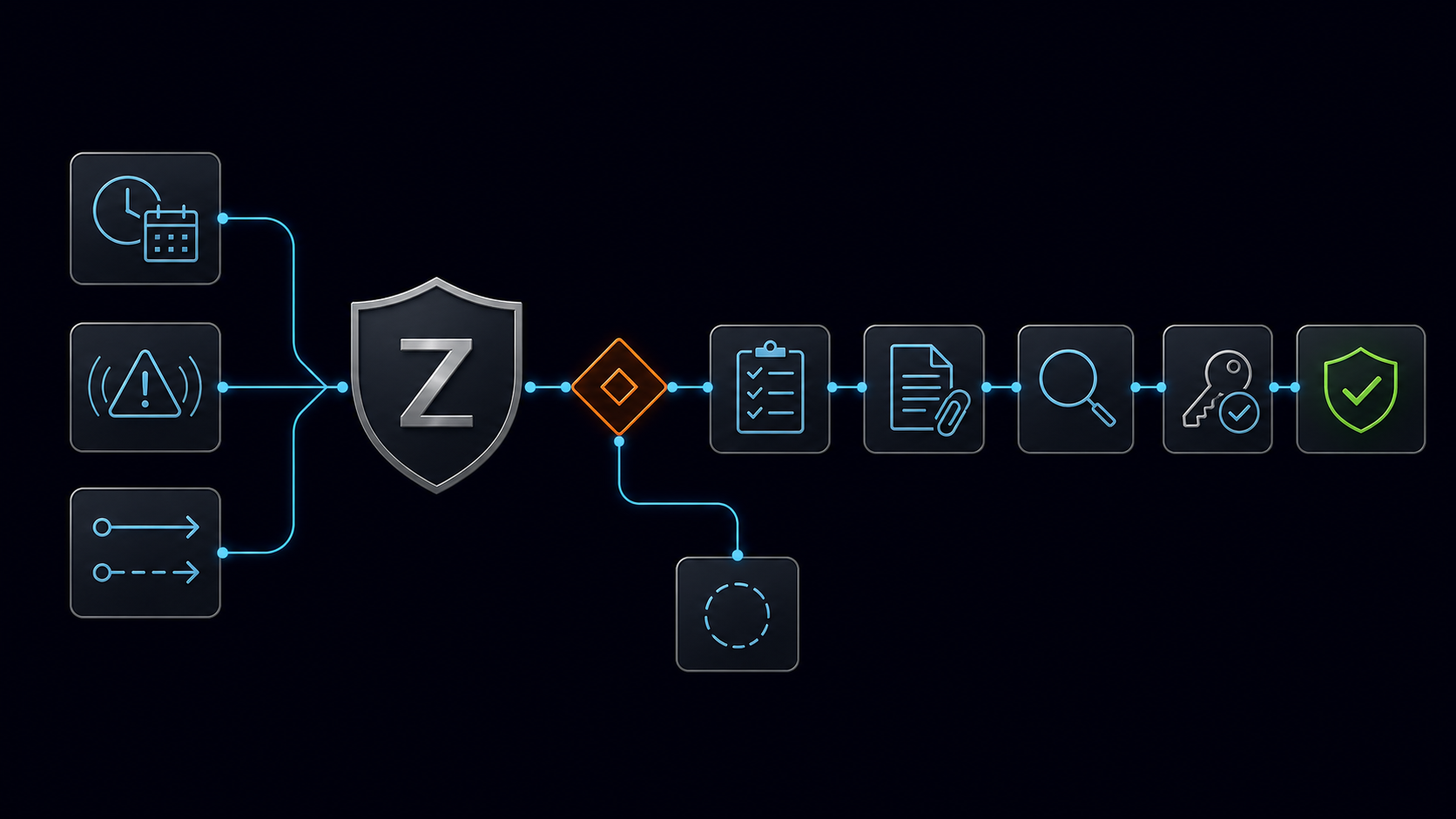
Zebsoft operational validation software connecting workflows evidence exceptions and assurance

THE OPERATIONAL GAP

Defining a Control Does Not Show That It Operated

Policies, procedures, registers and management systems define the intended position. They can identify requirements, risks, controls, responsibilities and review periods. That structure is necessary, but it does not automatically show that the affected person received the instruction, completed the work, supplied evidence or responded correctly when circumstances changed.

The gap between definition and operation is where compliance assumptions, missed activity and weak evidence accumulate.

Typical signs of the gap

  • A control is documented but nobody can show its latest operation
  • Owners learn about missed activity during an audit or incident
  • Evidence sits in email, shared drives and local spreadsheets
  • Completion is recorded without a separate verification decision
  • A failed response does not reliably initiate the next action
  • Management reports summarise status without traceable evidence

WHAT OPERATIONAL VALIDATION MEANS

A Controlled Route From Expectation to Accepted Outcome

Operational validation is the governed process of initiating required work, collecting current responses and evidence, identifying exceptions and retaining the human judgement that establishes the accepted position.

Defined criteria

The requirement, control, question, acceptance condition, owner and expected evidence are established before the activity is judged.

Visible operation

Scheduled work, event triggers, assignments, responses and due points make current activity visible to the right people.

Retained evidence

The system keeps the supplied information, attachments, dates, comments and linked records with the governed context.

Human verification

An authorised person accepts, rejects, qualifies or escalates the response and determines what must happen next.

THE VALIDATION ROUTE

Every Result Remains Connected to Its Purpose

ZAP preserves the relationship between the subject being governed, the required control, the returned evidence and the decision that follows.

01

Context

A requirement, risk, process, asset, supplier, employee, location or event establishes why validation matters.

02

Control

The organisation defines the required activity, criteria, timing, evidence, ownership and decision authority.

03

Trigger

A schedule, date, event, change, threshold or authorised request initiates the workflow.

04

Response

The responsible person completes the work and supplies the required information or evidence.

05

Verification

A competent reviewer considers the evidence and records the accepted, rejected or qualified outcome.

06

Assurance

The result updates visibility or creates an exception, action, reassessment or further validation.

Operating context → required control → schedule or event trigger → response and evidence → human verification → exception or assurance

DEFINE–COMMUNICATE–OPERATE–ASSURE

Validation Is Designed Into the Operating Model

The DCOA model keeps operational validation connected to the definition, communication and real work on which assurance depends.

Define

Set the governed subject, criteria, controls, roles, visibility, timing, evidence and decision authority.

Communicate

Deliver current information, assignments, changes and response requirements to the authorised audience.

Operate

Perform the check, task, submission, review, approval, investigation or other controlled activity.

Assure

Interrogate the approved information, verify the evidence and determine the accepted outcome or next action.

HOW VALIDATION STARTS

Scheduled, Triggered and Responsive Workflows

Not every control should be tested in the same way or at the same frequency. Zebsoft can initiate validation according to the nature and risk of the activity.

Scheduled validation

Start recurring checks, reviews, attestations, inspections or evidence requests at the approved frequency, with due dates and escalation.

Event-triggered validation

Initiate work when an incident, change, expiry, threshold, supplier event, failed control or other defined condition occurs.

Authorised responsive validation

Allow competent people to initiate a review, investigation or confirmation when judgement identifies a need outside the normal schedule.

VALIDATION WORKFLOW TYPES

Configure the Route Around the Control Being Tested

The underlying engine is reusable, but questions, evidence, people, stages and authority remain appropriate to the governed context.

Control checks

Ask whether an owned control is present and operating, collect evidence and retain a separate verification result.

Acknowledgement and attestation

Issue current information or a defined statement, record the response and make a missed or qualified response visible.

Evidence submission

Request a certificate, inspection record, approval, photograph, document or other defined evidence from the responsible person.

Operational inspection

Present approved questions and criteria, record findings and connect failed items to responsible follow-up.

Exception response

Route a missed, failed, rejected or disputed result into containment, review, reassessment, correction or escalation.

Effectiveness verification

Separate completion from effectiveness so an authorised reviewer can determine whether the response achieved the intended result.

THIS IS HOW ZEBSOFT SOLVES THE PROBLEM

From a Defined Control to a Live Assurance Position

The workflow below shows how operational validation closes the gap between written intent and current evidence.

01

Define the expectation

A process owner establishes the control, frequency, responsible role, evidence and acceptance criteria.

02

Initiate the work

ZAP creates the required activity on schedule or when an approved event or condition occurs.

03

Collect the response

The assigned person receives the relevant context and supplies the requested response and evidence.

04

Handle the exception

A missed, incomplete or failed result becomes visible and can create escalation or connected corrective work.

05

Verify the outcome

An authorised reviewer records whether the evidence is accepted and what effect it has on the assurance position.

VISIBILITY FOR EVERY RESPONSIBILITY

One Workflow, Different Views of the Same Truth

People need information appropriate to their responsibility. Operational validation gives each participant a usable view while preserving one connected record.

The person doing the work

Sees the current instruction, due point, questions, required evidence and permitted route for response.

The control owner

Sees due, completed, overdue, rejected and exception activity connected to the control they own.

The assurance team

Can examine criteria, responses, evidence, verification history, patterns and connected corrective work.

Leadership

Receives proportionate visibility of exposure, overdue work, recurring exceptions and the evidence behind the summary.

ONE ENGINE, MULTIPLE GOVERNANCE CONTEXTS

Apply Operational Validation Wherever Evidence Matters

ZAP can use a consistent validation logic across different domains while retaining their specialist criteria, terminology, scope and professional judgement.

Quality management

Validate process controls, product or service checks, corrective actions, objectives and approved changes.

Health and safety

Validate inspections, assigned controls, worker responses, equipment checks and follow-up after events.

Environmental management

Validate operational controls, monitoring, obligations, objectives, emergencies and improvement activity.

Information security

Validate owned controls, reviews, access activity, evidence requests, exceptions and treatment actions.

Supplier assurance

Validate approvals, due diligence, certificates, performance, corrective work and continued conditions.

Asset and maintenance

Validate inspections, maintenance evidence, calibration, operating condition and post-change review.

Employee assurance

Validate communication, required responses, learning, qualifications, checks and human competency decisions.

Integrated management

Reuse evidence and workflows across legitimate contexts without combining distinct requirements or judgements.

WORK WITH THE SYSTEMS YOU ALREADY HAVE

Replace Fragmentation or Add a Connected Assurance Layer

Zebsoft can operate as the principal management and assurance platform or alongside specialist systems that remain appropriate for engineering, finance, HR, service management, production or other operational purposes.

The objective is not to reproduce every specialist function. It is to connect the governed context, required control, responsible people, workflow and returned evidence so the organisation can see whether the intended arrangement is operating.

Implementation can begin with a defined validation route and expand as priorities, integrations and evidence sources become clearer.

A practical coexistence model

  • Keep specialist systems where they remain effective
  • Identify the controls and evidence that require assurance visibility
  • Use controlled imports, links or integrations where appropriate
  • Give owners one route for due work, exceptions and decisions
  • Phase migration away from spreadsheets and local trackers
  • Preserve human authority over interpretation and acceptance

ASSURANCE WITHOUT OVERCLAIMING

Evidence Supports Judgement; It Does Not Replace It

Operational validation improves visibility and traceability, but software does not guarantee compliance, control effectiveness or a safe outcome.

The platform controls the route

Zebsoft can issue work, apply permissions, retain evidence, identify exceptions and preserve the review and decision history.

People provide competent judgement

Authorised people interpret requirements, assess materiality, evaluate evidence and decide whether an outcome is acceptable.

Management owns the result

The organisation remains responsible for its requirements, controls, resources, operation, legal duties and assurance conclusions.

RESPONSIBLE USE OF AI

Analyse Authorised Evidence While Keeping Decisions Human

AI can help authorised users interrogate approved information and identify patterns across validation activity. It must not manufacture the facts or decisions on which assurance depends.

AI may support

  • Summarising authorised validation records for review
  • Highlighting overdue work, missing evidence and recurring exceptions
  • Finding relationships across audits, risks, incidents and actions
  • Supporting questions against information the user may access

AI must not invent

  • Requirements, controls or acceptance criteria
  • Operational responses, incident facts or supporting evidence
  • Approvals, rejections or verification outcomes
  • Professional, legal or management decisions

IMPLEMENTATION

Start With One Control Route and Build From Proven Operation

Operational validation can be introduced in a controlled sequence rather than attempting to digitise every possible check at once.

01

Select the use case

Choose a material control, recurring evidence problem or fragmented workflow with a clear owner and outcome.

02

Map the current route

Identify the trigger, participants, information, evidence, exceptions, authority and reporting need.

03

Configure and test

Build the route, test permissions and decisions with real users, and refine the evidence and escalation rules.

04

Operate and extend

Use the results to improve the route, then reuse the capability across further controls and contexts.

CONNECTED CAPABILITIES

Operational Validation Does Not Work in Isolation

Follow an outcome into the capability needed to manage the next part of the assurance route.

Audit management

Use programmes, audits, inspections and findings to test controls and create traceable follow-up.

Risk and controls

Relate a validation result to affected exposure, control ownership, treatment and review.

Incident management

Capture events, investigate relevant facts and connect response and improvement to the original context.

Task and action management

Assign responsible work, manage due points and dependencies, and verify completion and effectiveness.

PRACTICAL QUESTIONS

Operational Validation Software FAQs

These answers explain how ZAP supports dynamic control operation without replacing organisational responsibility or professional judgement.

What is operational validation software?

Operational validation software connects a defined requirement or control to scheduled or triggered work, responsible people, returned evidence, exceptions and human verification. It shows whether required activity occurred and what decision followed.

How is operational validation different from an audit?

An audit is one assurance activity, often performed at planned intervals. Operational validation can also use recurring checks, event triggers, attestations, evidence requests and effectiveness reviews between audits.

Does ZAP monitor everything continuously?

No. Continuous assurance means the approved validation routes operate throughout the relevant period. Each control should have a proportionate schedule, trigger or review method rather than an unsupported claim of constant real-time monitoring.

Can operational validation work across ISO standards?

Yes. The engine can support several standards and domains while each workflow retains its own scope, questions, criteria, evidence, authority and assurance judgement.

Can Zebsoft work with an existing QMS or GRC system?

Yes. Zebsoft can replace fragmented management tools or operate alongside appropriate specialist systems. The implementation should define where the governed record, workflow, evidence and accepted assurance position will be controlled.

What happens when a validation fails?

The failed or incomplete response remains connected to the original control and evidence. It can initiate escalation, containment, reassessment, incident response, corrective action, document change, training or follow-up validation.

Does completion mean a control is effective?

Not necessarily. Completion records that an activity occurred. Effectiveness requires suitable evidence and a competent person to determine whether the intended outcome was achieved.

Does operational validation software guarantee compliance?

No. It helps organisations operate defined controls, retain evidence and make exceptions visible. The organisation remains responsible for applicable requirements, competent decisions, resources and actual outcomes.

SEE OPERATIONAL VALIDATION IN ACTION

Use One Live Control to Demonstrate the Difference

Bring a recurring check, evidence request, overdue control, audit finding or failed action. We can show how Zebsoft turns it into visible work, retained evidence, controlled exception handling and a human-verified outcome.