System Structure
How the Zebsoft system is organised
Zebsoft is designed around how organisations actually manage responsibility, risk, and evidence — not around software feature lists.
Instead of separating functions into rigid products or forcing users into disconnected tools, the Zebsoft platform is structured using a small number of clearly defined concepts. Each layer has a specific role. Together, they form a single, coherent management system that can grow without rework or restructuring.
This page explains how those parts fit together.
The structural model
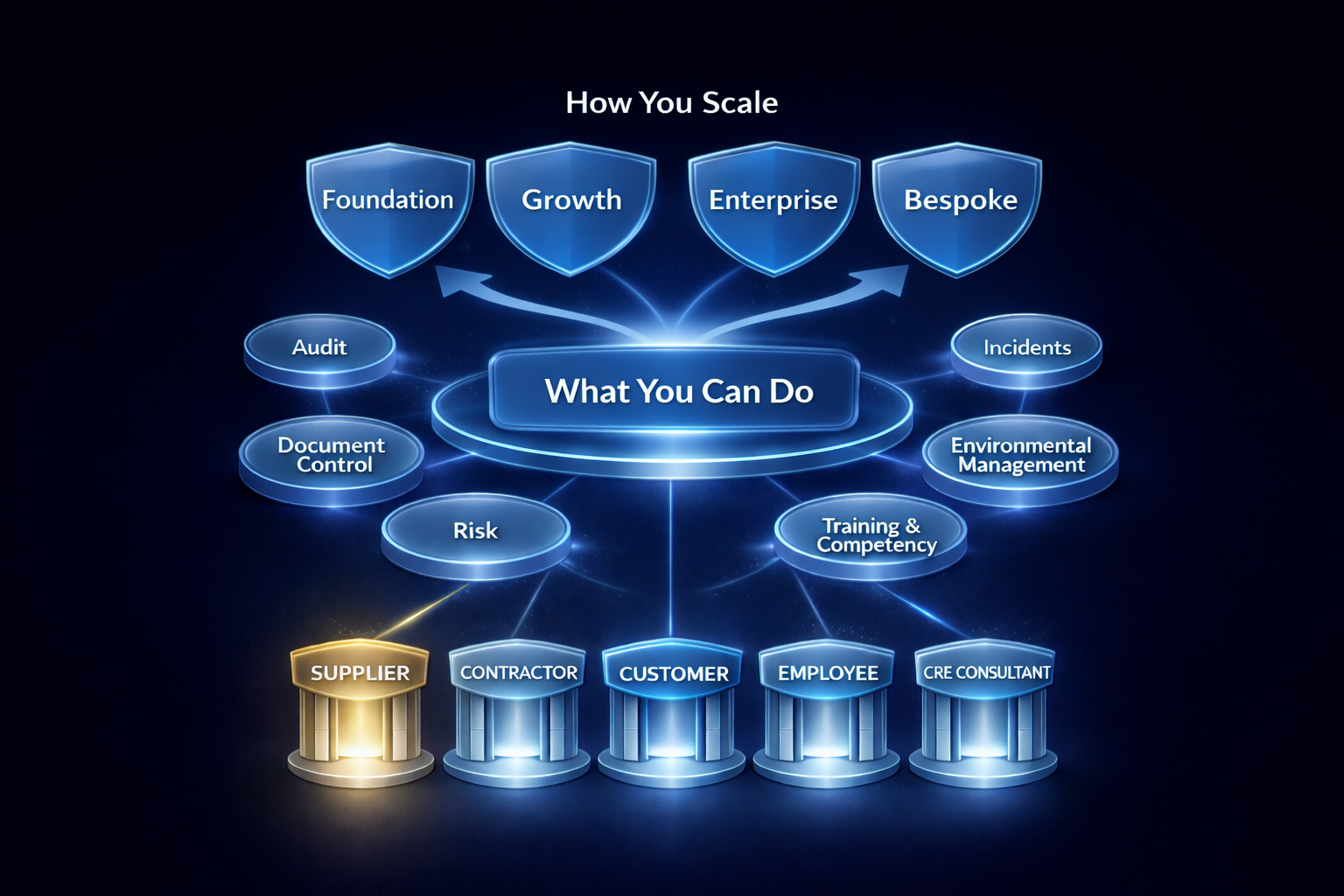
This diagram represents system architecture — not navigation, product bundles, or licensing.
The model shows how the platform is organised from the ground up:
- Shields show how far the system is extended
- Domains group responsibility across the organisation
- Capabilities provide the functional engines of the system
- Modules apply those capabilities in specific contexts
- Portals extend controlled access beyond the organisation
The structure remains consistent regardless of organisation size, industry, or regulatory framework.
Shields
Shields define how far the system is extended.
Shields represent scale, depth, and configuration — not separate systems.
The platform progresses from Foundation, through Growth, to Enterprise, unlocking additional capability, reach, and integration as organisational complexity increases.
A higher Shield does not replace a lower one. Each Shield builds on the same underlying structure, ensuring continuity as the organisation grows.
What changes is not how the system works, but how much of the organisation it connects.
Domains
Domains define areas of organisational responsibility.
A Domain represents a long-lived area of governance ownership, such as:
- Information Security
- Health & Safety
- Environmental & Sustainability
- Supply Chain Integrity
- Asset & Infrastructure Integrity
Domains do not introduce new tools. Instead, they group relevant capabilities together to manage a specific focus area without fragmenting control or duplicating data.
Domains exist to make complex systems understandable while preserving a single source of truth.
Capabilities
Capabilities are the functional engines of the system.
Capabilities perform work and generate evidence. Examples include:
- Audit
- Risk
- Document Control
- Incident Management
- Change Management
- Training & Competency
- Business Continuity
Capabilities are reusable across the entire platform. The same audit process, risk register, or document structure can support multiple Domains and multiple standards.
This is what allows Zebsoft to support integrated management systems without duplication.
Modules
Modules apply capabilities within a specific context.
A Module is a configured instance of a Capability, aligned to a Domain, standard, or operational requirement.
For example:
- A Risk Capability applied to the Information Security Domain
- An Incident Capability applied to Health & Safety
- A Document Control Capability applied across multiple standards
Modules allow the system to adapt to different compliance needs while maintaining shared evidence and consistent governance.
Portals
Portals extend the system beyond the organisation.
Portals allow controlled interaction with external parties such as:
- Suppliers
- Customers
- Contractors
- Employees
- Consultants
Each portal user sees and contributes only what they are authorised to access. Governance, traceability, and accountability are maintained at all times.
Portals extend reach without weakening control.
Example: Foundation Shield
An organisation operating on the Foundation Shield might:
- Control policies and procedures
- Run internal audits
- Track actions and corrective work
- Maintain a basic risk register
They are structured, compliant, and in control — without unnecessary complexity.
Example: Enterprise Shield
A regulated, multi-site organisation operating on Enterprise might:
- Run multiple Domains across the business
- Share audits, risks, and evidence across standards
- Manage suppliers and contractors through Portals
- Maintain full traceability from risk to action to evidence
The system scales without changing how people work — it simply connects more of the organisation.