
Shield Levels
Choosing the right scale for your organisation
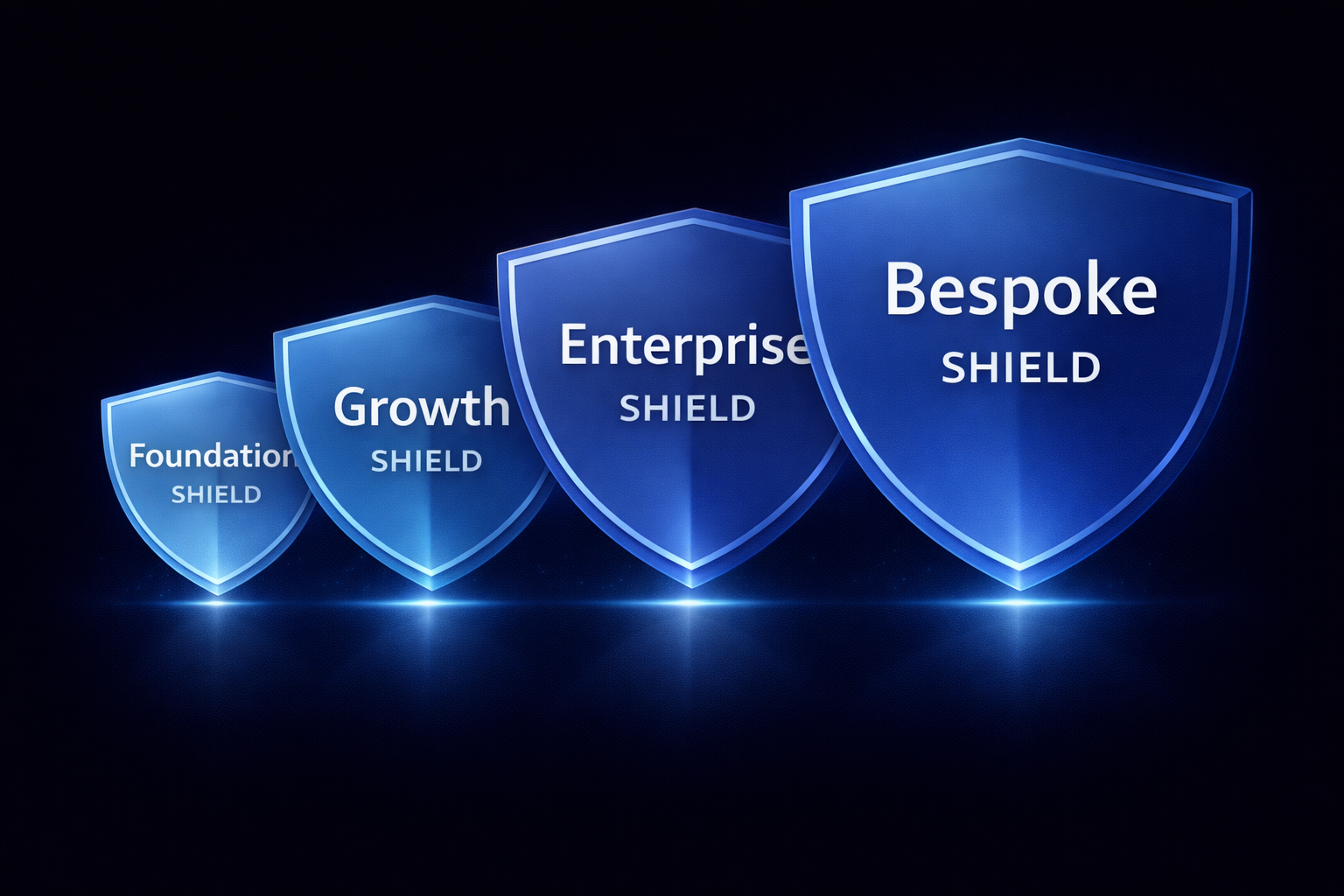
Zebsoft is delivered through Shield Levels, which define how far the platform is extended across an organisation.
Shield Levels are not separate products.
They represent scale, depth, and reach — allowing organisations to start with a strong foundation and expand without re-implementation, disruption, or loss of control.
This page explains what each Shield level provides and how to choose the right starting point.
What a Shield Level Represents
A Shield Level determines:
- How much of the organisation is connected
- How many Domains are actively governed
- How advanced the control and automation is
- Whether external parties interact through Portals
What does not change:
- The underlying system structure
- The way evidence is generated
- The governance model
Each Shield builds on the same core architecture.
Foundation Shield
The Foundation Shield is designed for organisations establishing formal compliance and governance for the first time — or bringing structure to systems that already exist informally.
Typical use cases include:
- Single-site or small multi-site organisations
- Internal compliance teams
- Early certification or re-certification programmes
What the Foundation Shield provides:
- Core governance structure
- Document control
- Audits and actions
- Risk management
- Internal users only
The Foundation Shield creates a certifiable, controlled baseline that can be expanded later without redesign.
Growth Shield
Deeper control as complexity increases
The Growth Shield is designed for organisations that have outgrown basic compliance management and need greater depth, automation, and visibility.
Typical use cases include:
- Growing organisations
- Multiple standards or regulatory frameworks
- Increased internal accountability requirements
What the Growth Shield adds:
- Advanced audits and tasks
- Additional Domains
- Greater reporting and oversight
- Expanded configuration options
The Growth Shield increases capability without changing how people work — it simply connects more of the organisation.
Enterprise Shield
Governance at scale
The Enterprise Shield is designed for complex, regulated, or distributed environments where control must extend beyond the core organisation.
Typical use cases include:
- Multi-site or multinational organisations
- Regulated sectors
- Extensive supplier or contractor networks
What the Enterprise Shield enables:
- External Portals (suppliers, customers, employees, contractors)
- Advanced permission and visibility models
- Cross-Domain and cross-standard traceability
- High-assurance governance
The Enterprise Shield allows organisations to govern entire ecosystems, not just internal teams.
Bespoke Shield
The Bespoke Shield is used where standard governance models are not sufficient.
Typical use cases include:
- Sector-specific regulatory frameworks
- Specialist operational requirements
- Custom workflows and reporting
The Bespoke Shield adapts the Zebsoft architecture to meet precise organisational needs while preserving consistency and control.
How Shield Levels Work Together
Shield Levels are cumulative.
- Moving to a higher Shield does not replace the previous level
- Data, evidence, and structure are retained
- Users continue working in the same system
This allows organisations to grow their compliance capability without disruption or re-implementation.
Choosing the Right Starting Point
Most organisations begin with the Shield that matches their current complexity, not their future ambition.
You can:
- Start small and expand later
- Add Domains over time
- Introduce Portals when needed
The system is designed to grow at the pace of the organisation.