
Portals
Controlled collaboration beyond the organisation
Zebsoft
uses Portals to extend governance beyond the core organisation while maintaining control, traceability, and accountability.
Portals are not separate systems and they are not informal access points.
They are governed extensions of the Zebsoft platform, designed to allow external parties to interact without weakening oversight.
This page explains what Portals are, how they work, and when they are used.
What a Portal Is
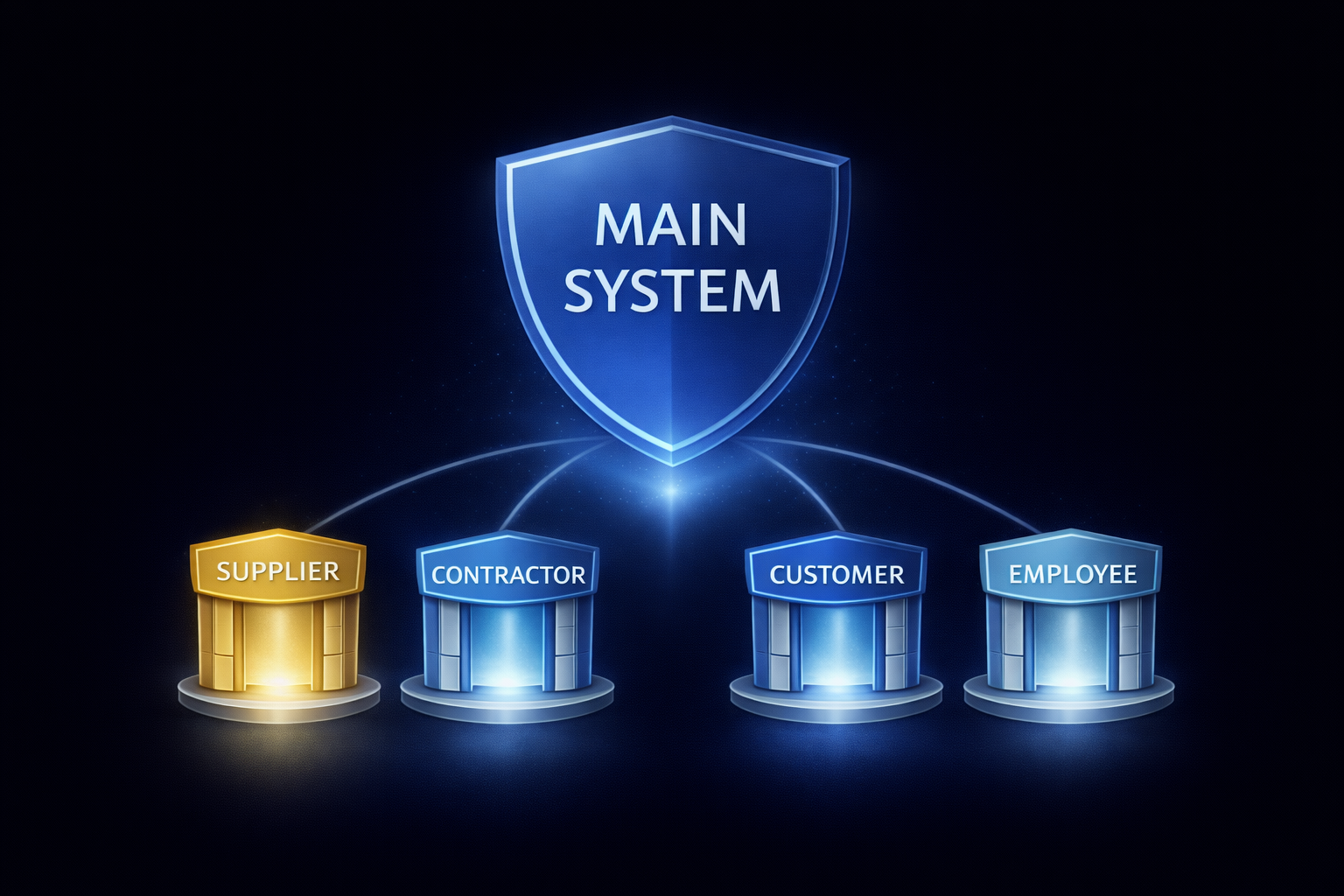
A Portal is a controlled access layer for people who are not core system users.
It allows external parties to:
- View information they are authorised to see
- Submit evidence or data where required
- Participate in governed processes
Portals answer the question:
“How do people outside the organisation interact with the system — safely?”
They extend reach without surrendering control.
Why Portals Matter
Many organisations rely on email, shared folders, or spreadsheets to manage suppliers, contractors, customers, or consultants. This creates risk, inconsistency, and loss of traceability.
Portals solve this by:
- Maintaining permission-based access
- Preserving audit trails
- Preventing uncontrolled data sharing
- Keeping evidence inside the governed system
Portals allow collaboration without governance dilution.
How Portals Work in Zebsoft
Portals are built on the same underlying system structure as internal users.
This means:
- Access is role-based
- Visibility is restricted by design
- Actions are logged and traceable
- Evidence is stored centrally
Portal users do not see “the system” — they see only what is relevant to their role and authorisation.
Types of Portals
Zebsoft supports multiple Portal types, each aligned to a specific interaction model.
Supplier Portal
Used to manage suppliers, contractors, and external providers.
Supports:
- Compliance document submission
- Ongoing supplier monitoring
- Risk and performance oversight
- Controlled communication
Customer Portal
Used to share controlled information with customers.
Supports:
- Access to relevant documentation
- Visibility of compliance status
- Evidence sharing without data sprawl
Employee Portal
Used to extend system interaction to wider internal audiences.
Supports:
- Training and competency records
- Policy acknowledgement
- Task and action participation
Consultant or Partner Portal
Used where external advisors or partners support governance activity.
Supports:
- Multi-client interaction
- Controlled evidence access
- Clear separation of responsibility
Portals and Governance
Portals do not bypass governance rules.
All Portal activity:
- Respects system permissions
- Is logged and attributable
- Links directly to Domains, Modules, and Capabilities
This ensures external interaction strengthens governance rather than weakening it.
Portals and Shield Levels
Portals are typically introduced at higher Shield Levels, where governance must extend beyond internal teams.
- Foundation focuses on internal control
- Growth prepares the system for wider interaction
- Enterprise applies Portals across external ecosystems
The Portal model remains consistent regardless of scale.
When Portals Are Used
Portals are appropriate when:
- Evidence must be collected from external parties
- Information must be shared without loss of control
- Accountability must remain visible across boundaries
They are not used for convenience — they are used for governed interaction.